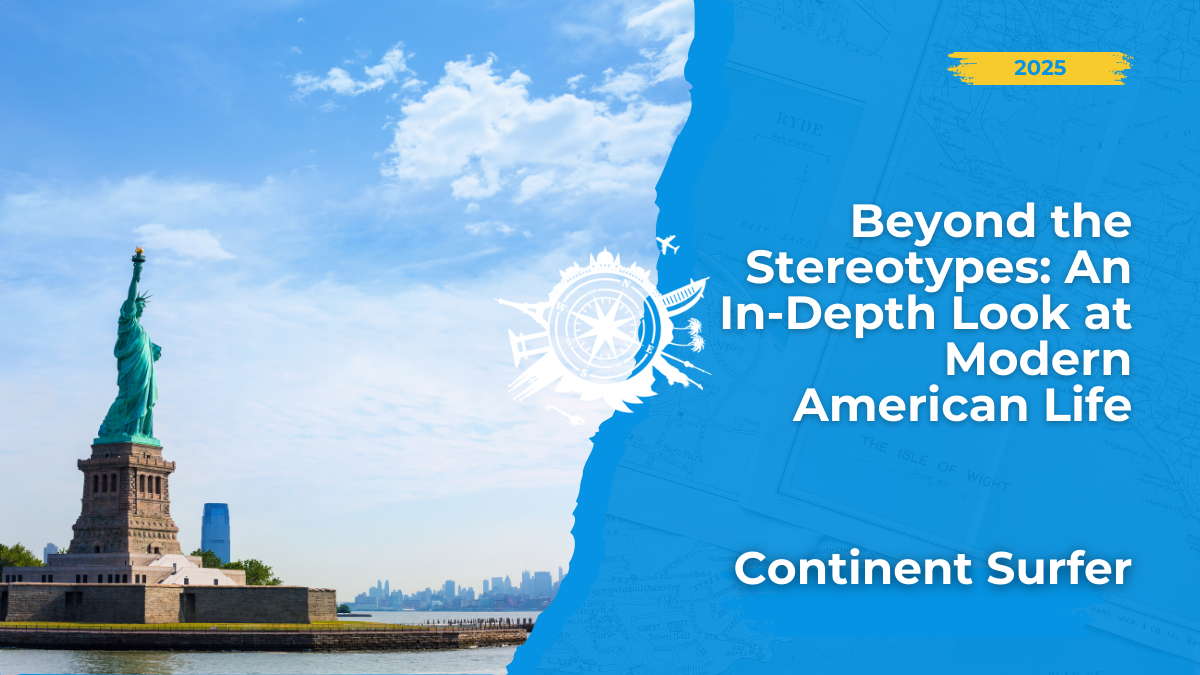
Beyond the Stereotypes: An In-Depth Look at Modern American Life
The United States is often reduced to a few dominant cultural images—from Hollywood films to fast food—but the reality of modern American life is far more intricate and diverse. This article moves past these familiar clichés, delving into the nation’s complex cultural landscape, the dynamic interplay of its regional identities, and the evolving nature of the American Dream itself. By examining the country’s mosaic of peoples, ideas, and economies, we gain a more nuanced and accurate understanding of this powerful and varied nation.
written by: BW – Continent Surfer
One of the greatest misconceptions about the U.S. is the idea of a singular “American culture.” In reality, the country is a collection of distinct regional cultures, each with its own history, dialect, cuisine, and political leanings.
- The Pacific Northwest (Washington, Oregon) is defined by a blend of high-tech innovation, a strong environmental focus, and a thriving coffee and craft beer scene.
- The Deep South (e.g., Mississippi, Alabama) is shaped by its rich, often difficult, history, characterized by deep-rooted traditions, distinctive Southern hospitality, and unparalleled comfort food.
- New England (e.g., Massachusetts, Maine) retains a sense of colonial history, prioritising academic excellence, maritime industries, and an understated, reserved demeanour.
- The Midwest (“The Heartland”) is often noted for its manufacturing base, expansive agricultural lands, and a reputation for directness and friendliness often termed “Midwestern nice.”
These geographical differences are not merely superficial; they drive local politics, influence economic priorities, and create a fascinating and decentralised national character.
The American Mosaic: Immigration and Identity
The U.S. has always been defined by immigration, and its demographic profile is rapidly changing. It is truly a “nation of nations,” where identity is not a fixed entity but a constantly negotiated space. Today, modern American life is increasingly shaped by:
- The Rise of the Second and Third Generations: Many Americans maintain strong ties to their ancestral homelands, creating a rich blend of global traditions integrated into local communities. Think of the vibrant Vietnamese-American community in Houston or the Polish-American heritage of Chicago.
- Multilingualism: Despite English dominance, Spanish is widely spoken, and countless other languages are heard daily, particularly in large metropolitan areas. Schools and services increasingly reflect this linguistic diversity.
- The “Third Culture Kid” Phenomenon: An increasing number of Americans have lived abroad or have parents from different countries, creating a worldview that is neither strictly American nor purely inherited, but a unique hybrid.
The common stereotype of the homogenous American is shattered by a stroll through any major city, which showcases a global exchange of ideas, food, and perspectives.

The Evolving American Dream
The classic image of the American Dream—a house, two cars, and a comfortable life attained solely through hard work—is undergoing significant revision. For many young and modern Americans, success is defined differently:
- Focus on Experience over Ownership: Younger generations often prioritise experiences, travel, and personal freedom over accumulating traditional assets.
- Prioritising Work-Life Balance: The old expectation of working 60-hour weeks is being challenged by a push for flexible hours, remote work, and better mental health accommodations.
- Civic Engagement: Far from being purely individualistic, modern American life sees significant levels of grassroots political and social activism, often centered around issues of climate change, social justice, and equality.
The pursuit of happiness remains central, but the definition of that happiness is far more diverse and focused on well-being and community impact than the traditional economic metrics of the past.

Technology and the New Town Square
Technology is fundamentally restructuring American society. While the image of Americans glued to their phones might be a cliché, the impact of digital life is profound and complex. Social media platforms now serve as the new “town square,” where local news is shared, national debates are fought, and communities are built.
This digital shift has created both immense opportunity and significant division. It allows for instant connection across vast distances but has also led to a struggle with misinformation and the challenge of navigating life in increasingly polarized digital echo chambers. The search for authentic connection in a hyper-connected world is a defining challenge of modern American life.
The United States is a land of continuous motion and contradiction: a high-tech superpower with enduring small-town values; a consumer culture grappling with a new wave of minimalism; and an individualistic society driven by passionate collective action. Moving beyond the flat, familiar stereotypes and embracing this complexity is essential. Modern American life is not a simple image, but a vast, intricate, and perpetually evolving story, and it is in these nuances that the true, fascinating character of the nation is found.
Did you know?
The United States has no official language at the federal level. While English is spoken by the vast majority and is used for government business, the U.S. Constitution and federal law do not mandate it as the official language. This historical choice reflects the country’s origins as a polyglot nation, a fact that underscores the linguistic and cultural diversity often overlooked by simple stereotypes.

Like what we do?
If so, please support us, every little counts and is much appreciated!
You will help us to come up with useful information regularly, so please support us every once and a while or even monthly! Thank you!
Source(s):
Original article
Join the Continent Surfer community!
Subscribe to our newsletter and be the first to receive the latest news, useful tips, and exclusive offers!
Comment